
Mineral Resources and Ore Reserves - How the lack of direct data impacts uncertainty and risk
The reporting of an Ore Reserve is an explicit admission that a company has completed a comprehensive technical and commercial study concluding that extraction is viable. However, many new and existing mines underperform – in extreme cases closing prematurely.
Ore Reserves underpin mining investment and Ore Reserve risk can be categorised as technical or non-technical. Staff estimating Ore Reserves are acutely aware of the technical uncertainties that impact risk. However, technical uncertainties are not always well understood by decision makers and non-technical staff, principally the lack of direct observational data for estimating Mineral Resources and Ore Reserves.
Typically, drilling data is the principal source of direct technical input to Mineral Resources and Ore Reserves. To illustrate how much direct observational data is available for resource and reserve estimation, Derisk has calculated the volume of diamond drilling data completed at a modest porphyry copper project amenable to open pit mining in Indonesia. The table below documents the size of the deposit together with the direct data inputs that contribute to estimation of Mineral Resources and Ore Reserves.
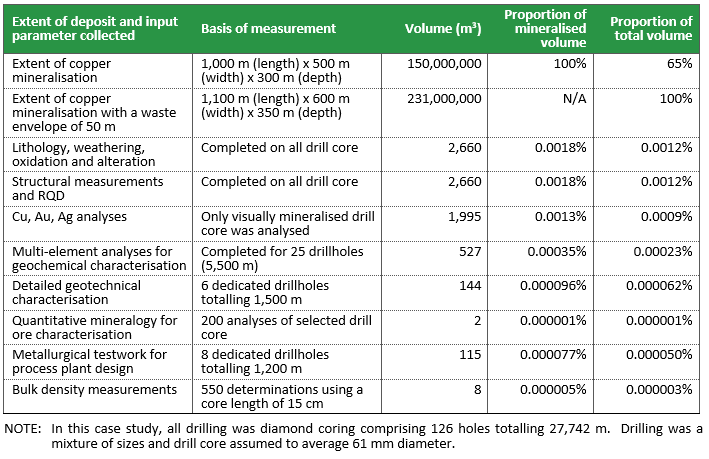
This case study illustrates the fundamental problem of limited direct observational data. At best, geologists have direct measurements equivalent to 0.0018% of the mineralised volume of the deposit to estimate resources. Mining staff have substantially less direct data to estimate reserves – from 0.00001% to 0.0012% of the volume of the mineralisation and waste envelope. Yet, this deposit has been classified as both Indicated and Inferred Mineral Resource and can support a substantial Probable Ore Reserve.
Conventional analyses of technical risk classify risk into generic inputs such as geology, resource and reserve estimation, geotechnical analysis, metallurgical testwork, etc. Conventional risk analyses do not convey uncertainty due to lack of direct data and are therefore deficient. Often, this deficiency does not get communicated to decision makers, many of whom are not technical and have little appreciation of how little direct data underpins a mining investment decision that could be in the billions of dollars.
The following text represents an example of what should be included in every Ore Reserve report:
“The Mineral Resource used to derive the Ore Reserve was estimated from a database that has directly sampled 0.002% of the deposit. This direct observational data has been supplemented with a range of indirect data that provides inferences that help to characterise but not quantify the nature of the mineral deposit. Technical inputs to the Modifying Factors contributing to the Ore Reserve have been estimated from a database that has directly sampled significantly less than 0.002% of the deposit”.
Derisk considers that technical uncertainty, hence risk, in Ore Reserves arises mainly from two sources – the limited direct observational data available, and the interpretation and analysis of direct and indirect observational data. This fundamental lack of direct data is poorly understood by many decision makers.
Improved communication of data paucity is crucial in better informing decision makers on the sources of uncertainty in Mineral Resource and Ore Reserve estimates.
For more information
Mark Berry (Director and Principal Geologist)
+61 4 0802 9549
mark@deriskgeomining.com